
Dartmouth Resident Lookup Record Trail
One Dartmouth resident lookup does not produce a single master profile. Each official record settles a different question. An assessor card ties a tax owner to a parcel and may show a tax mailing address. A voter record concerns election registration. A docket identifies a court matter, not an official case file. Probate can connect a decedent, executor, or heir, while a civil certificate follows its own access rules. Begin with the source that fits the question, keep its date, and avoid treating a business or parcel link as proof that a person lives at a particular address.
| Record | What it can confirm | Custodian or channel | Access boundary |
|---|---|---|---|
| Assessor card | Owner of record, parcel situs, tax mailing address, sale or legal reference | Dartmouth Vision and Assessor | Public, but owner is not necessarily an occupant |
| Map parcel | Parcel geometry, identifier, owner link, adjacent parcels | Dartmouth MapGeo or MassGIS | Public display, with deed verification needed |
| Voter status or list | Election registration and listed residence | Secretary form or Dartmouth Town Clerk | Individual form or local-list request; protected rows omitted |
| Annual street list | Dated household listing as of January 1 | Dartmouth Town Clerk | Printed-list notice; protected fields are limited |
| Court docket | Name variant, case number, event, disposition, court | MassCourts and filing clerk | Portal is not the official file; restricted cases are unavailable |
| Probate file | Decedent, petitioners, executor, heirs, and estate events | Bristol Probate and Family Court | Public unless impounded |
| Vital record | Birth, marriage, or death event details | Town Clerk, RVRS, or State Archives | Eligibility, identification, fees, and historical rules apply |
| Business or license filing | Business affiliation, role, or public credential | Town Clerk, Corporations Division, DOL | Not proof of a private home address |
For a current Dartmouth address question, begin with the Vision property record and preserve both the card date and the distinction between parcel situs and tax mailing address. For a name that may be connected to an estate, court filing, or dated event, start with the appropriate custodian rather than trying to force every source into an address search.
Confirm a Dartmouth Resident Match
Verification is a two-source task. Start with the full name and a lawful, dated identifying fact such as an approximate age, former address, ZIP, or parcel number. Name forms matter in Dartmouth records. A middle initial can appear or disappear, a surname may be hyphenated or spaced differently, and an entity or trust can own the property. Keep a short log with the exact spelling searched, the source, the date shown, and the record number. That record of comparison is more useful than collecting a long list of uncertain name matches.
- Anchor the name in a Dartmouth property record or another dated local filing. Record the tax mailing address, situs address, legal owner, and card as-of date separately.
- Search the name and sensible variants in the appropriate court or probate index. Save the court, case number, case type, and file date before opening details.
- Compare a second independent link such as a probate relationship, deed date, public business filing, or properly available historical vital record. Do not publish a date of birth simply because a display makes it visible.
- Ask the office holding the file for its copy or inspection procedure when a finding matters. A clerk can explain the record number and process without disclosing protected fields.
- Docket
- A court's running case log, showing filings, events, and sometimes dispositions. It is a locator, not automatically the complete official file.
- Index versus image
- An index points to a record by name or number. An image is a copy of the document or screen record and may have separate access or completeness limits.
- Certified copy
- A copy issued and authenticated by the responsible office for an official purpose. It is different from an online reference result.
Note: A same-name court row becomes meaningful only after its court, date, party role, and any lawfully displayed matching detail fit the Dartmouth record trail.
Dartmouth Court Name Search
The Massachusetts Trial Court portal is a useful name locator for Dartmouth matters, but it is not the official case file. Choose a Court Department first, then a Division. The available location choices depend on that selection. A civil name search requires a last name with an initial capital followed by lowercase letters and at least two characters; a first name is optional or conditional and needs at least one character when used. A case-type search uses a begin and end date, with a one-month maximum range. Exact case-number and ticket searches also require the portal's capitalization, spacing, and leading-zero rules.
| MassCourts field or tab | Use in a name check |
|---|---|
| Court Department | Required first dropdown; it controls the available later fields. |
| Court Division | Required dropdown; division choices depend on the selected department. |
| Court Location | Conditional dropdown or autocomplete that can populate from the division. |
| Number of Results | Optional control for the number of displayed results. |
| Name tab, Last Name | Required for civil name search; initial capital followed by lowercase, minimum two characters. |
| Name tab, First Name | Optional or conditional; initial capital followed by lowercase, minimum one character. |
| Name tab, Company Name | Use for a company party instead of individual last and first name fields. |
| Case Type, Begin and End Date | Both dates are required for that tab, and the search range cannot exceed one month. |
| Case Type | Required dropdown after department and division selection. |
| Case Number | Exact text, including capitalization, spacing, and leading zeros. |
| Ticket/Citation Number | Use the exact citation number supplied by the court. |
See the MassCourts public-access screen before searching. The portal can show party or company, case number, case type, file date, initiating action, party type, case status, court, affiliation, and a legally displayed date of birth. A case can appear more than once because each party may create a result row. Detail pages can add parties, event dates, docket entries, dispositions, and some documents.
Log a result as a short docket inventory rather than a general personal profile:
- Party or company name and party type
- Case number and case type
- File date and initiating action
- Case status and court location
- Affiliation and any lawfully displayed date field
- Detail-page events, docket dates, and disposition
The MassCourts public-access screen is the image source; the official court-search instructions explain the portal's tabs and access limits.
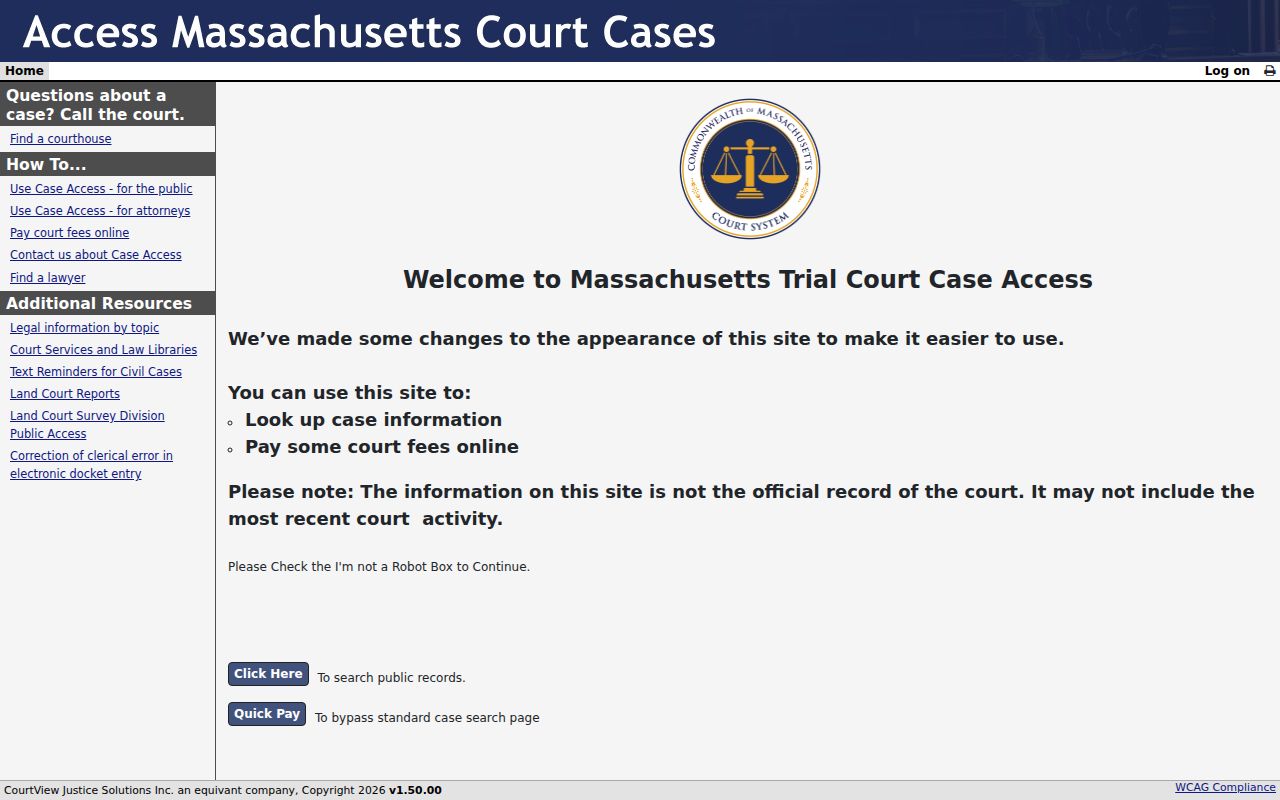
The public-entry screen is only the first channel. For a current official file, correction, or a record not fully visible online, use the filing court's clerk or public terminal.
For Dartmouth, New Bedford District Court is the listed local district venue, while Bristol County Superior Court and probate matters use Bristol County locations. The source court, party role, and disposition must be read before drawing any conclusion from a name match.
Dartmouth Probate Name Leads
Probate is the right record path when the question concerns a deceased person, an executor, an heir, a will, guardianship, or an estate transfer. Bristol Probate and Family Court in Taunton keeps the file channel for Dartmouth estate matters. Use the docket to identify the case number and parties, then inspect the public physical file or courthouse kiosk when the online result is incomplete. An impounded file remains unavailable even if a similar name appears elsewhere.
A cautious sequence is obituary or death clue, probate docket, petition and executor names, then a later deed or estate transfer. That chain can distinguish two people with the same name and can help a family historian identify the next custodian. It does not turn a surviving relative, mailing address, or court appearance into proof of a current personal address.
Dartmouth Vital Record Check
Vital records are not a browsable current name index. The Dartmouth Town Clerk keeps local births, deaths, marriage intentions, and marriage licenses, while the Registry of Vital Records and Statistics handles statewide records generally from 1936 forward. Older state returns belong with the State Archives. For an event that happened in Dartmouth, use the event town rather than a later mailing address. A person may have lived in town but been born, married, or died elsewhere.
| Request channel | Documented Dartmouth and Massachusetts rule |
|---|---|
| Town Clerk | Start here for a local event or marriage intention filed in Dartmouth, using the clerk's local procedure. |
| RVRS current request | Provide a name, event date and place, identification, fee, and any required relationship proof. RVRS does not offer a browsable online index. |
| RVRS mail form | Up to five searches may be requested; the usual search is a 10-year window centered on the supplied date. |
| State Archives | Historical registers can provide dated residence, parent, spouse, occupation, and burial clues, subject to collection availability. |
The Massachusetts certificate-ordering page documents current eligibility, channel, fee, and restriction rules. The documented fees are $20 in person, $32 by mail, and $42 for expedited mail, while online or phone requests through VitalChek cost more. Birth and marriage records generally become genealogically open after 90 years, and death records after 50 years. Restricted categories include pre-adoption material, births to unwed parents, and death records containing protected Social Security information. A negative statement records the completed search boundary when the office does not locate a record.
Dartmouth Voter Record Check
The Secretary of the Commonwealth's voter-status form is an individual self-status confirmation, not a public resident directory. It asks for first name, last name, date of birth, five-digit residential ZIP, and an agreement checkbox. Dartmouth's web election material publishes results and precinct resources, not an open name-by-name town roster. A local voter or street-list request goes to the Town Clerk under the Town's records-access policy and should identify the date, precinct or street, fields, and preferred format.
Public local voter records can include name, residence and mailing address, party or unenrolled designation, voter ID, active or inactive status, registration and inactivity dates, voting history, and prior changes. Confidential voters, minors, phone and email, veteran status, and permanent-absentee status are withheld. The statewide voter file is not a general public record. Use the individual voter-status form only as the Commonwealth describes it, and do not use a ZIP plus a name as a bulk-search substitute.
Dartmouth Records by the Numbers
Dartmouth's 2026 census notice states that the annual street list is available from the Clerk's office for $20. The Town's reported precinct table in a 2025 annual-report snippet totals 22,896, but the table date and header should be checked before quoting it as a current enrollment figure. The important local point is the annual-census connection: two years of nonresponse can make a voter inactive and may lead to removal from the rolls. Completing the census itself does not register a person to vote.
This dated list is useful as a time-stamped household clue, not a complete statement about everyone associated with Dartmouth. Keep the list year attached to any finding. A status shown in an annual record can change, and protected rows are intentionally not part of a general current-person search.
Dartmouth Business Name Context
A business filing can help separate same-name people, but it answers a business question. Dartmouth business certificates are local DBAs that identify the listed owners and address without certifying zoning, health, building, or licensing compliance. The statewide Corporations Division searches entity name, individual officer or director, identification number, and filing number. Its searchable universe includes articles, annual reports, registered agents, officers, managers, signatories, dissolutions, liens, UCC, trademarks, and related filings.
Use the Massachusetts Corporations Division search to compare an exact name and likely spelling variant, then note filing type, date, entity status, address type, and role. A registered agent or officer can show an organizational affiliation with Dartmouth, but it does not establish ownership or occupancy of a Dartmouth home. Public license searches can add board, license type, number, status, location, and expiration as a second, limited identifier.
The following Corporations Division source page is the reference for the officer and entity search options shown here.
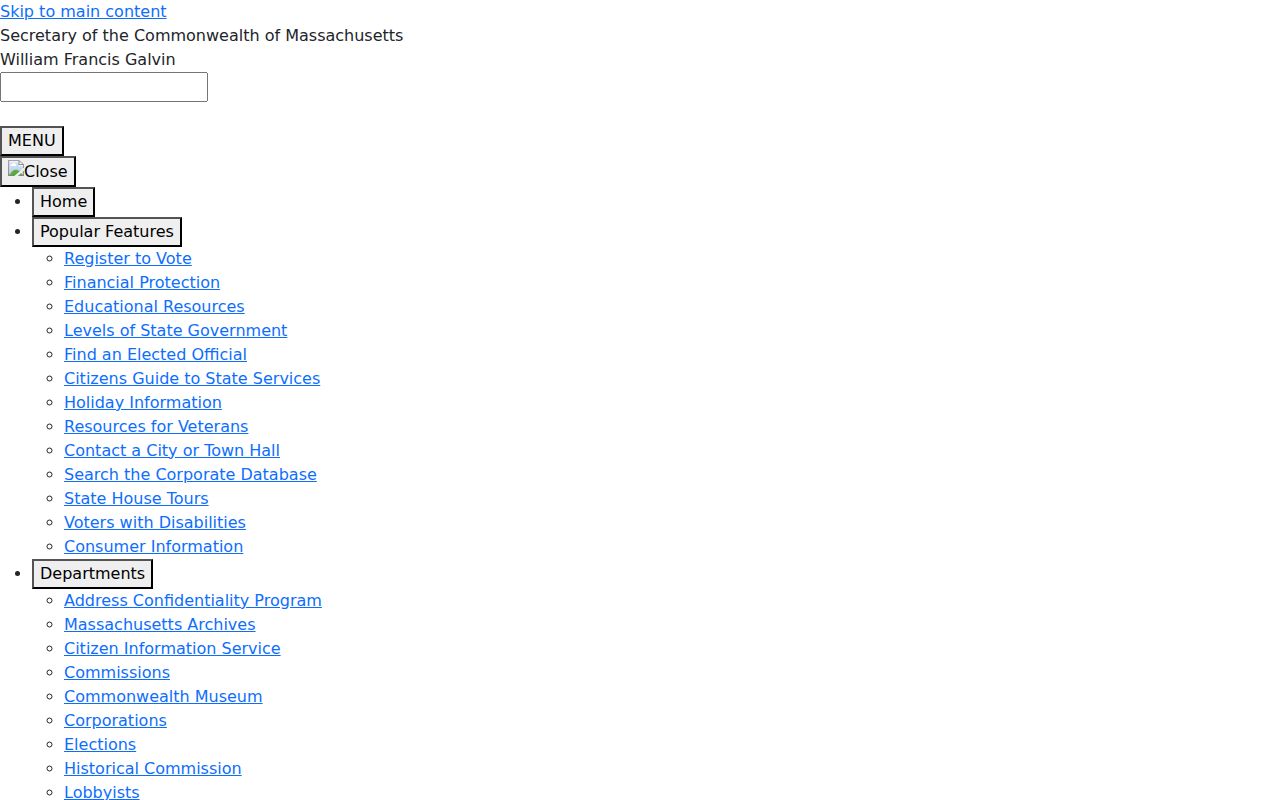
Compare a filing date and role with the parcel or court date before treating a business result as the same person in the local verification chain.
Dartmouth Historical Name Checks
For a former resident, the best corroboration may be outside a modern index. Dartmouth Library's Southworth reference service can help locate Town Reports from the 1890s, Chronicle microfilm from the 1960s, catalog material, Ancestry Library Edition, and HeritageQuest. DHAS holds family groups, Quaker material, burial lists, maps, house histories, and local land resources. A dated yearbook, newspaper notice, family-group entry, or cemetery clue can place a person in the area during a period, but it remains a lead until an appropriate custodian confirms the material claim.
The Dartmouth local-history service is a practical starting channel when an online record is missing. Town cemeteries are public places, yet no official online municipal interment index was located. Record the cemetery, plot or burial request, search date, and contact channel rather than treating an empty web result as proof that no burial occurred.
Dartmouth Records When Indexes End
When an online search ends, ask for an existing, reasonably described record from the office that holds it. Dartmouth's Records Access Officer process accepts local requests by the documented mail, email, or in-person channels. Under the Massachusetts Public Records Law, M.G.L. c. 66, § 10, an RAO generally must issue a written response within 10 business days. Exemptions in M.G.L. c. 4, § 7(26) and the request's scope still matter. Narrowing the record type, date range, and fields can make inspection or a redacted extract more useful than a broad request.
The Dartmouth public-records access policy identifies the local routing path. The Bristol County Sheriff's public site supplies facility and custody context but no accessible name-search roster was located. For a sheriff-held record, use its public-records channel rather than assuming a roster exists online.
The Bristol County Sheriff's official site is the source for the facility context and records channel.
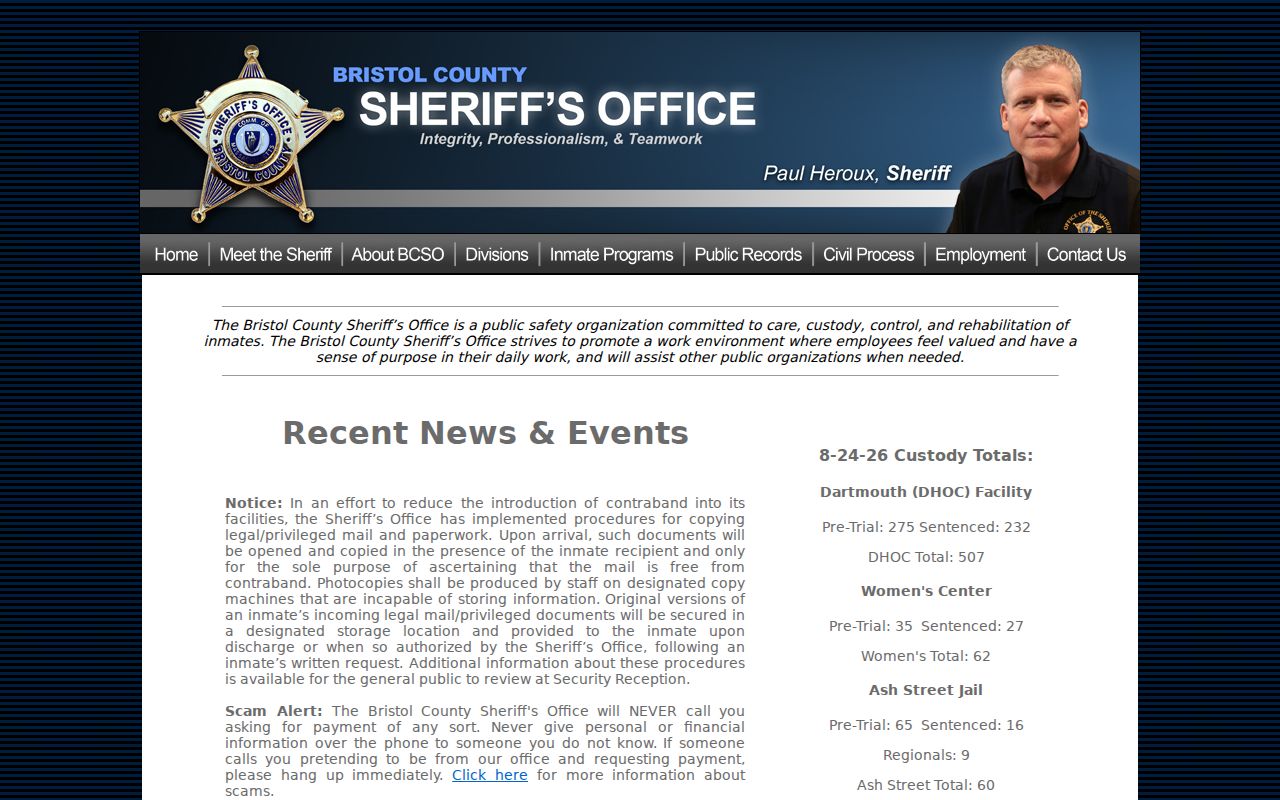
A missing online roster is a limit to preserve, not a gap to fill with a private profile or a guess.
Dartmouth Privacy Record Limits
A name-record search has firm boundaries. Massachusetts confidentiality rules can shield voter information and use a confidential voter number instead of a name and address. The Address Confidentiality Program under M.G.L. c. 9A and 950 CMR 130.00 protects eligible people through a substitute mailing address. A discrepancy, an older address, or the absence of a public row is a protection signal, not an invitation to combine records in an effort to expose someone. Vital, court, school, and motor-vehicle records also carry specific restrictions.
Official records and commercial data-broker tools serve different purposes. The official route identifies the custodian, as-of date, and access rule for a record. Commercial neighbor and people-search categories can combine older public material with marketing or user-supplied data, so a same-name result can be stale or wrong. They should not replace a Dartmouth custodian's record or be used to profile or contact a person.
Lawful use. Use Dartmouth records for personal, civic, family-history, or consumer-safety research. Using names, addresses, or records to stalk, harass, intimidate, or harm a person is prohibited and may violate Massachusetts law.